Beyond the Global Gaze: Kummatty and Local Cinema
Updated: Jun 14
Kummatty illustrates the enduring value of local cinema, challenging the dominance of the global gaze and affirming the importance of stories rooted in their own cultural worlds.
We often consume what I call global or semi-global cinema, a category almost synonymous with Hollywood. Over time, I grew weary of its dominant white gaze and felt compelled to break away, embarking on a journey into international cinema to seek out other stories and perspectives. This exploration led me to a firm belief: cinema should be a deeply local art form. As a mass medium, it holds immense power to homogenize culture, especially when capitalism turns storytelling into a commodity endlessly duplicating formulas where low-quality copies become tired clichés and high-quality imitations win awards. A film like Kummati demonstrates precisely why local cinema matters; it is extraordinary, yet it required Martin Scorsese's restoration and validation to gain visibility, revealing how even subaltern art often depends on the white gaze for legitimacy. I believe every story deserves attention, even the most familiar romance, because it belongs to someone. In this blog, I want to emphasize the vital importance of regional and local cinema and argue why we must learn to see beyond the white gaze from the point of view of Kummati.
Far from symbols of innocence alone, children in cinema often become the medium through which filmmakers examine the invisible forces that govern society.
One of the most significant functions of children in cinema is their ability to make politically sensitive realities visible without directly foregrounding political discourse. Positioned at the margins of power, children experience the consequences of social structures more immediately than they understand them, allowing filmmakers to reveal complex political ideas through everyday actions, emotions, and relationships. In Abbas Kiarostami's Where Is the Friend's House?, a child's simple attempt to return a notebook becomes an exploration of patriarchal authority and social hierarchy. In Jafar Panahi's Taxi, the director's niece exposes the tensions between official moral codes and lived social realities, revealing questions of class, censorship, and privilege through her encounters with the world. Majid Majidi's Children of Heaven uses the fears and responsibilities of children to illuminate the pressures of poverty, familial obligation, and social inequality. Hirokazu Kore-eda's Nobody Knows presents childhood as a site of abandonment and institutional failure, where children are forced to assume adult responsibilities in the absence of care, exposing the fragility of the social systems meant to protect them. Michael Haneke's The White Ribbon goes further still, portraying childhood as the space where authoritarian values are learned and internalized, suggesting that the roots of fascism lie within the everyday structures of discipline, patriarchy, and obedience. Across these films, children are not merely protagonists or symbols of innocence; they function as a cinematic lens through which filmmakers can investigate the most sensitive dimensions of society.
Their vulnerability, sincerity, and relative distance from ideological language allow cinema to approach subjects such as patriarchy, class inequality, social neglect, censorship, and authoritarianism with a clarity that adult perspectives often cannot achieve. The child in these films becomes a politically charged figure, not because they articulate political arguments, but because their experiences reveal how power operates at its most intimate level within families, schools, communities, and the everyday rituals through which societies reproduce themselves. In this sense, the recurring use of children in cinema is not simply an aesthetic or narrative choice; it is a profoundly political strategy that enables filmmakers to expose the hidden mechanisms through which social values, inequalities, and forms of authority are transmitted across generations.
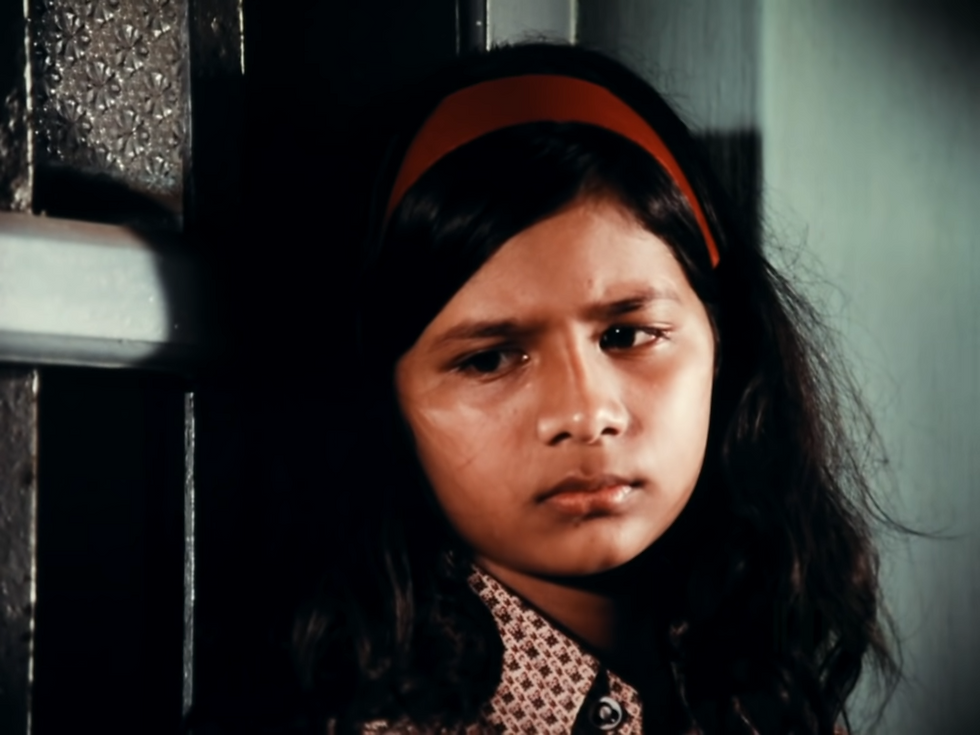
In G. Aravindan's Kummatty, childhood becomes a space through which contrasting modes of socialization are explored. The film presents two distinct worlds of children: on one side are the village children, whose lives are deeply intertwined with nature, folklore, communal experience, and the rhythms of rural life. Their world remains open-ended and exploratory, shaped less by rigid instruction than by curiosity, imagination, and direct engagement with their surroundings. They move freely through fields, forests, and village paths, inhabiting a space where myth and reality coexist without clear boundaries. In contrast, the young girl from the bourgeois household embodies a more regulated and disciplined mode of childhood, one structured by social expectations, domestic order, and class privilege. While materially secure, her experience appears more constrained, mediated through the values and boundaries imposed by her upbringing. Aravindan does not present this contrast merely as a difference between rural and urban life or poverty and privilege; rather, he examines how class shapes a child's relationship to freedom, imagination, and the world itself. The village children possess a degree of autonomy that allows them to encounter mystery, folklore, and transformation on their own terms, while the bourgeois child approaches these experiences from within a framework already defined by authority and social conditioning. Through the figure of Kummatty and the intrusion of myth into everyday life, the film suggests that childhood is not a universal condition but one profoundly shaped by the cultural and class environments in which children are raised.
One of the most remarkable aspects of Kummatty is its visual beauty. G. Aravindan, who was a painter before becoming a filmmaker, brings a painterly sensibility to every frame, imbuing the film with a quiet elegance and balance. What is particularly striking is the neutrality with which he observes the world of the film. Neither the bourgeois household nor the village landscape is privileged over the other; both are presented with the same attentiveness, dignity, and visual care. Aravindan's gaze remains free of judgment, allowing each space to exist on its own terms within the film's larger universe. This sense of equilibrium not only enhances the film's aesthetic richness but also reinforces its thematic exploration of childhood, class, and imagination, making Kummatty feel as timeless today as it did upon its release.
Kummatty constructs a world where childhood, folklore, and magical realism intersect, using a child's journey to reflect on freedom, imagination, and the forces that shape human experience.

Kummatty unfolds in a rural village inhabited largely through the perspective of children. Their days are shaped by school, open landscapes, village paths, and the rich world of folklore that circulates through the community. Among the stories they grow up hearing is that of Kummatty, a mysterious wandering figure . Kummatty is both fascinating and frightening. When he eventually appears in the village, the children are initially cautious, observing him from a distance as they try to reconcile the legendary figure of their stories with the person standing before them.

As their curiosity gradually overcomes their fear, the children begin to approach Kummatty and engage with him directly. Through a series of encounters, they discover that he is not the monstrous or supernatural figure they had imagined but someone who appears remarkably human, possessing magical abilities. What follows is a relationship built on wonder, playfulness, and mutual fascination. The children attempt to understand Kummatty through their own innocent lens, while Kummatty, in turn, becomes a participant in their world of imagination and freedom.

The narrative takes a dramatic turn when Kummatty transforms the children into different animals. While most are eventually restored to their human forms, one child, transformed into a dog, becomes separated from the group and remains trapped in his new identity. From this point onward, the film shifts its focus toward the journey of this child. Moving through different social spaces, the dog encounters Kummatty transforms the children into different animals. Through these encounters, the film gradually expands beyond a simple folktale into a meditation on childhood, freedom, social conditioning, and belonging.
The child's return to human form completes the narrative arc, but not before the film has used his transformation to explore the tensions between imagination and social order, innocence and authority, and the different ways individuals come to inhabit the worlds around them. Through its blend of folklore, magical realism, and a child's perspective, Kummatty constructs a rich cinematic universe that is at once playful, philosophical, and deeply attentive to the social realities embedded within everyday life.
Magical realism in Kummatty functions as an epistemological bridge, connecting the world of folklore and collective memory with the rational structures of modernity.

Kummatty employs magical realism not merely as a source of wonder or fantasy, but as a way of holding together forms of experience that realism alone cannot adequately contain. Fredric Jameson's account of magical realism is particularly useful here. For Jameson, magical realism emerges in societies where pre-capitalist and capitalist modes of life coexist within the same social space. It becomes a narrative form capable of representing the tensions between these worlds when conventional realism can no longer accommodate them simultaneously. Realism tends to privilege linear chronology, rational causality, and clearly legible social structures; magical realism, by contrast, allows multiple temporalities, belief systems, and ways of understanding reality to exist side by side.
This framework illuminates Aravindan's use of the supernatural in Kummatty. The film is situated precisely at the intersection of two worlds: the older world of folklore, communal memory, and myth, and the emerging rationality associated with modernity and bourgeois social life. The village children inhabit a universe where stories, legends, and everyday experience flow seamlessly into one another, while the bourgeois household represents a more regulated and disciplined understanding of reality. Rather than privileging one over the other, Aravindan places both within the same cinematic space and grants them equal legitimacy.
In this regard, Kummatty shares certain affinities with the magical realism of Thangalaan. In Pa. Ranjith's film, the supernatural becomes a means of recovering histories that exist outside official archives, histories preserved through folklore, collective memory, and fragmented narratives. Similarly, the figure of Kummatty belongs not to documented history but to the realm of living memory passed down through generations. The film treats this realm as equally real, refusing the modern tendency to dismiss myth as mere superstition or fantasy.
The child's transformation into a dog becomes central to this project. Moving between different social spaces, the transformed child traverses the boundary between folklore and modernity, freedom and discipline, imagination and social conditioning. Through this journey, the film stages a confrontation between competing ways of understanding the world. The supernatural is therefore not an escape from reality but a method of expanding reality itself, allowing Aravindan to capture forms of experience that realism alone might reduce or exclude. Magical realism becomes an epistemological bridge, connecting pre-capitalist cultural memory with the rational structures of an emerging modern society and revealing how both continue to coexist within the lived reality of the village. Through Kummatty's world, Aravindan suggests that myths, folktales, and collective memories are not remnants of a vanished past but active forces that continue to shape identity, imagination, and social life in the present.
The Birth of the Rational Actor .The dog episode reveals how bourgeois power turns hierarchy into common sense, teaching the child to replace emotional attachment with rationalized systems of value.

The scene involving the country dog and the Pomeranian is not merely about a family's preference for one animal over another; it is a small but revealing demonstration of how class hierarchy reproduces itself through both knowledge and authority. The father's insistence that the country dog be abandoned in favor of a pedigree breed is presented not as a personal prejudice but as a rational decision. Crucially, this judgment is legitimized by the veterinarian, whose professional expertise transforms what is fundamentally a class preference into an objective truth. Here, class and knowledge work together. The father's bourgeois consciousness supplies the hierarchy, while the veterinarian's scientific authority naturalizes it. What might otherwise appear as an arbitrary cultural preference acquires the appearance of neutral, expert knowledge. This is precisely what Michel Foucault identifies as the relationship between power and knowledge: authority does not merely exercise power through force but through the production of truths that appear self-evident. The superiority of the Pomeranian over the country dog is therefore not simply asserted; it is validated through institutional knowledge, making the hierarchy appear natural rather than ideological.
The father's decision reproduces a colonial hierarchy of value that survives long after colonial rule itself. What is being rejected is not simply a dog but an entire symbolic association with the local, the ordinary, and the non-elite. The veterinarian's endorsement allows this hierarchy to masquerade as scientific common sense.
The bourgeois household in Kummatty functions as a disciplinary space through which these values are reproduced. The house is not merely a physical structure but a carefully regulated environment organized around order, propriety, and distinction. Every object, relationship, and activity within it reflects the values of the class that inhabits it. Unlike Chindan and the village children, whose experiences are shaped by open landscapes, collective life, and relatively unrestricted movement, the daughter occupies a bounded world. Her interactions are mediated through supervision, protection, and instruction. She is protected from uncertainty, from the environment beyond the household, and from forms of social interaction that fall outside the norms of her class. In Foucauldian terms, discipline here operates through the organization of space, behavior, and everyday routines. The child learns bourgeois values not through direct ideological lessons but through inhabiting an environment that continuously reinforces them.
Yet the deeper mechanism at work is not restriction but production. Power is effective because it creates subjects who willingly reproduce its logic. When the father insists on replacing the country dog with a Pomeranian, he is not simply imposing a rule; he is helping produce a particular kind of subjectivity. The daughter is gradually shaped into someone who will eventually desire the Pomeranian herself, experiencing this preference not as an inherited class value but as her own personal taste. This is one of the central insights of both Foucault and Althusser: ideology is most effective when it no longer appears ideological. The child internalizes the hierarchy until it becomes indistinguishable from common sense. What begins as external authority becomes self-regulation.
What emerges here is the formation of a specifically bourgeois rationality. The child learns that emotional attachment must yield to supposedly objective criteria of worth. Grief over the country dog becomes unintelligible because it cannot be justified within the value system being imposed upon her. The replacement of one dog with another is presented as a rational exchange, and resistance to that exchange appears irrational. This logic extends beyond the dog itself. Relationships, objects, and experiences are increasingly understood through their exchange value. What matters is not the uniqueness of the bond but the relative value of what occupies its place.
The daughter's grief becomes significant because it expresses a fundamentally human refusal of exchangeability. She does not experience the country dog as an object among other objects but as a singular companion whose loss cannot be compensated for by acquiring a better version. Her sadness emerges from memory, attachment, and emotional continuity. Yet bourgeois rationality reclassifies these experiences as irrational. The father's intervention teaches her that emotional attachment is an unreliable basis for judgment because value is determined by external hierarchies rather than lived experience. The problem is not simply that the country dog is replaced; it is that mourning its loss is subtly delegitimized.
The scene also reveals a deeper process of objectification. The dying dog is not treated as a living being with whom one has shared a relationship but as an object whose usefulness has ended. At the same time, the Pomeranian is not valued as a living creature in its own right; it functions primarily as a superior replacement. Both animals are reduced to their position within a hierarchy of value. The lesson being taught is that loss should be resolved through substitution: if one object disappears, another can take its place. Such a view undermines the emotional reality of grief, which arises precisely because relationships are not interchangeable. Human beings mourn because memories, attachments, and shared experiences cannot simply be transferred to a replacement.
In learning to objectify the dog, the daughter simultaneously learns to objectify aspects of herself. Her loneliness, sadness, and emotional investments are rendered secondary to the rational order being imposed upon her. The production of the bourgeois subject therefore involves more than the internalization of class values; it requires the disciplining of affect itself. By teaching the child that everything can be replaced, the household gradually transforms relationships into exchangeable relations and trains her to understand the world through value, distinction, and substitution rather than through emotional attachment and lived experience.
Beyond economic change, Kummatty examines how class hierarchy survives through inherited values, tastes, and everyday forms of social conditioning.
Kummatty was made during a significant period in Kerala's history. The Kerala Land Reforms Act of the late 1960s and early 1970s had fundamentally altered the state's social structure by weakening the power of large upper-caste landowning families and transferring rights to tenants. The bourgeois household depicted in the film belongs to precisely the class whose economic dominance was being challenged by these reforms. By the time Kummatty was released in 1979, the traditional foundations of that class had already begun to erode.
What makes Aravindan's critique particularly interesting, however, is that it extends beyond property and economics. The film suggests that changing ownership patterns alone does not automatically transform the values, desires, and social attitudes that sustain class hierarchy. Land can be redistributed, but habits, tastes, and systems of belief are often passed down from one generation to the next. The father's preference for the Pomeranian over the country dog is one example of this process. The film implies that even when material structures change, the cultural logic of privilege can continue to survive through the people who inherit and reproduce it. In this sense, Kummatty is less concerned with class as an economic category than with the everyday ways ideology is learned and maintained.
The film's historical context becomes even more significant when viewed alongside the aftermath of the Emergency (1975–77), a period marked by state surveillance, censorship, and restrictions on civil liberties across India. Against this backdrop, Kummatty's recurring concern with discipline, authority, and freedom acquires a broader political resonance. The contrast between the regulated world of the bourgeois household and the relative freedom enjoyed by Chindan and the village children speaks to larger questions about control and autonomy. Chindan's ability to move freely through the world, guided by curiosity rather than supervision, can be read as a reminder of a form of freedom that had recently come under threat. For audiences watching the film in 1979, these concerns would not have felt abstract; they would have resonated with memories of a period when personal freedom and dissent had been subject to unprecedented control.
Kummatty balances celebration and critique, affirming the value of folk traditions while exposing the mechanisms through which power reproduces itself in modern society.
At the same time, Kummatty invites a critical question about the limits of its own project. One possible reading is that the film celebrates folk culture without granting it genuine political agency. Kummatty himself appears as a wandering outsider who brings magic into the village and then disappears, while the material conditions of village life remain largely outside the frame. From this perspective, the film risks aestheticizing rural existence, transforming it into an object of contemplation for audiences who are not required to inhabit its realities. In such a reading, Kummatty becomes a beautiful meditation on a world already left behind, viewed from a position of distance rather than participation.
Yet this interpretation overlooks an important distinction between romanticizing a way of life and recognizing the validity of its knowledge systems. Romanticization treats the village as a lost world whose value lies primarily in its beauty or innocence. Aravindan's film, however, appears to make a stronger claim. The folk tradition in Kummatty is not merely decorative; it functions as the film's primary way of understanding reality. Myth, folklore, and collective memory are not presented as quaint cultural remnants but as legitimate forms of knowledge that coexist alongside, and sometimes challenge, modern rationality. This is where the film's use of magical realism becomes crucial. Rather than treating folklore as an object to be observed, the film asks the viewer to inhabit its logic.
The distinction becomes even clearer when one considers the film's treatment of the bourgeois household. Aravindan does not simply celebrate village life; he subjects elite social structures to careful scrutiny. The film's examination of class hierarchy, discipline, colonial value systems, and the production of bourgeois subjectivity demonstrates a level of social critique that exceeds mere nostalgia. The village is granted epistemological legitimacy, while the bourgeois world is revealed as a system that actively reproduces power through rationality, knowledge, and discipline. This simultaneous movement of celebration and critique prevents Kummatty from collapsing into a pastoral fantasy. What emerges instead is a film that argues for the validity of alternative ways of knowing while remaining attentive to the social and political forces that shape the worlds in which those forms of knowledge survive.
Kummatty demonstrates why regional cinema matters: it preserves local histories, knowledge systems, and forms of life that globalized storytelling often cannot represent on their own terms.
Ultimately, Kummatty demonstrates why regional cinema remains indispensable in a world increasingly dominated by globalized forms of storytelling. Large-scale cinema, by virtue of its need to appeal to broad audiences, often gravitates toward recognizable narratives, familiar archetypes, and universally legible conflicts. While such films can be artistically valuable, they frequently leave little room for the specificity of local histories, folk traditions, systems of knowledge, and forms of life that exist outside dominant cultural frameworks. Regional cinema operates differently. It is rooted in particular landscapes, languages, memories, and communities, allowing stories to emerge from lived realities rather than from the demands of market universality. It is within these local worlds that cinema can engage with power, class, caste, childhood, folklore, and social transformation in ways that resist simplification.
Kummatty exemplifies this possibility. Through its use of childhood, folklore, and magical realism, the film constructs a world that cannot be fully understood through the categories of conventional realism or through the expectations of a global cinematic gaze. Aravindan's village is not merely a setting but a repository of collective memory, oral traditions, and cultural practices that coexist uneasily with the rationality of modernity and bourgeois social life. The film's political insights emerge not through overt ideological statements but through the everyday experiences of children, through myths that continue to shape reality, and through forms of knowledge that exist outside institutional authority. In doing so, Kummatty reminds us that the most profound political questions are often embedded within the most local and seemingly ordinary experiences.
This is also why regional and subaltern storytelling carries a particular importance within postcolonial societies. For centuries, many communities have existed outside official archives and dominant narratives. Their histories survive through songs, folklore, myths, rituals, and collective memory rather than through institutions that traditionally determine what counts as legitimate knowledge. To approach these worlds solely through the frameworks of realism, modern rationality, or externally imposed standards of representation is to risk missing the very forms through which these communities understand themselves. Magical realism, folklore, and oral storytelling therefore become more than aesthetic choices; they become ways of preserving and communicating experiences that would otherwise remain invisible.
The emergence of cinema from historically marginalized communities whether among tribal groups, oppressed castes, or linguistic minorities further underscores this point. Such films do not merely add diversity to an existing cinematic landscape; they challenge the assumptions through which that landscape has been organized. They insist that every community possesses its own histories, cosmologies, and ways of making meaning. The value of these stories does not depend on their recognizability to a global audience or their validation by dominant cultural institutions. Their importance lies in their ability to articulate experiences from within, to speak in their own languages, and to preserve forms of life that larger systems of representation have often ignored or misunderstood.
To look beyond the white gaze, then, is not simply to consume films from different regions. It is to recognize that cinema is at its richest when it allows multiple worlds to exist on their own terms. Films like Kummatty remind us that storytelling is not only about representation but about the preservation of memory, identity, and cultural imagination. In an increasingly homogenized cinematic landscape, regional cinema remains one of the few spaces where the local can still speak in its own voice, where marginalized histories can reclaim visibility, and where communities can narrate themselves rather than be narrated by others.


Comments